How I use Capacities as a Zettelkasten
In this newsletter I'm going to share how I use Capacities to take — and more importantly, to review — my notes, and share a little bit about a larger project that I'm using it to write.
I've bounced around a lot in my note-taking practices. I've flirted with Obsidian, and maintained bullet journals for many years. Since last August, I've mostly been using Capacities, and it's probably been the most use I've gotten out of any of my note-taking and journalling systems.
In this newsletter I'm going to share how I use Capacities to take — and more importantly, to review — my notes, and share a little bit about a larger project that I'm using it to write.
Capacities
Capacities organizes notes around two core concepts: The "daily note," and "objects."
Objects are types of notes, with metadata. Capacities defines some basic ones for you — the daily note is itself an object, that has a date, tags, a text area, and templates — and then you can also add custom types. For instance, I have a few custom types that I use to manage my in-season notes on football games— teams, weeks, games, and seasons. Games are always linked to two teams, a week, and a season, and then there's a section where I take freeform text notes. Besides the football stuff, the main custom object I have defined is a Zettel. (More on that in a minute.)
The daily note is, well, a daily note. It's the easiest place to jot something down in the phone app, so it's where a lot of my "thoughts while waiting in line at the grocery store" end up, or my notes from reading. Capacities lets you define a template your daily note (and for any object type!). I try to keep mine simple: It pulls a random Zettel out of the Zettelkasten section of my Capacities workspace, and also adds the #unprocessed tag to the whole note.
The Zettelkasten
A Zettelkasten is a way of organizing notes, and ideas from notes, that was basically invented by Niklas Luhmann to help him write sociology papers. For a really thorough overview I recommend reading Introduction to the Zettelkasten Method but the basic idea is pretty simple.
- A Zettelkasten is a collection of Zettels, small "atomic" notes that should each contain a single idea
- A Zettel has a unique identifier
- A Zettel has links to other Zettels
Sometimes the identifier is hierarchical, and encodes what idea the original Zettel was inspired by or was most connected to when you originally created it. This is called a "Luhmann-ID." There's a lot of debate about whether this is necessary or helpful in digital Zettels.
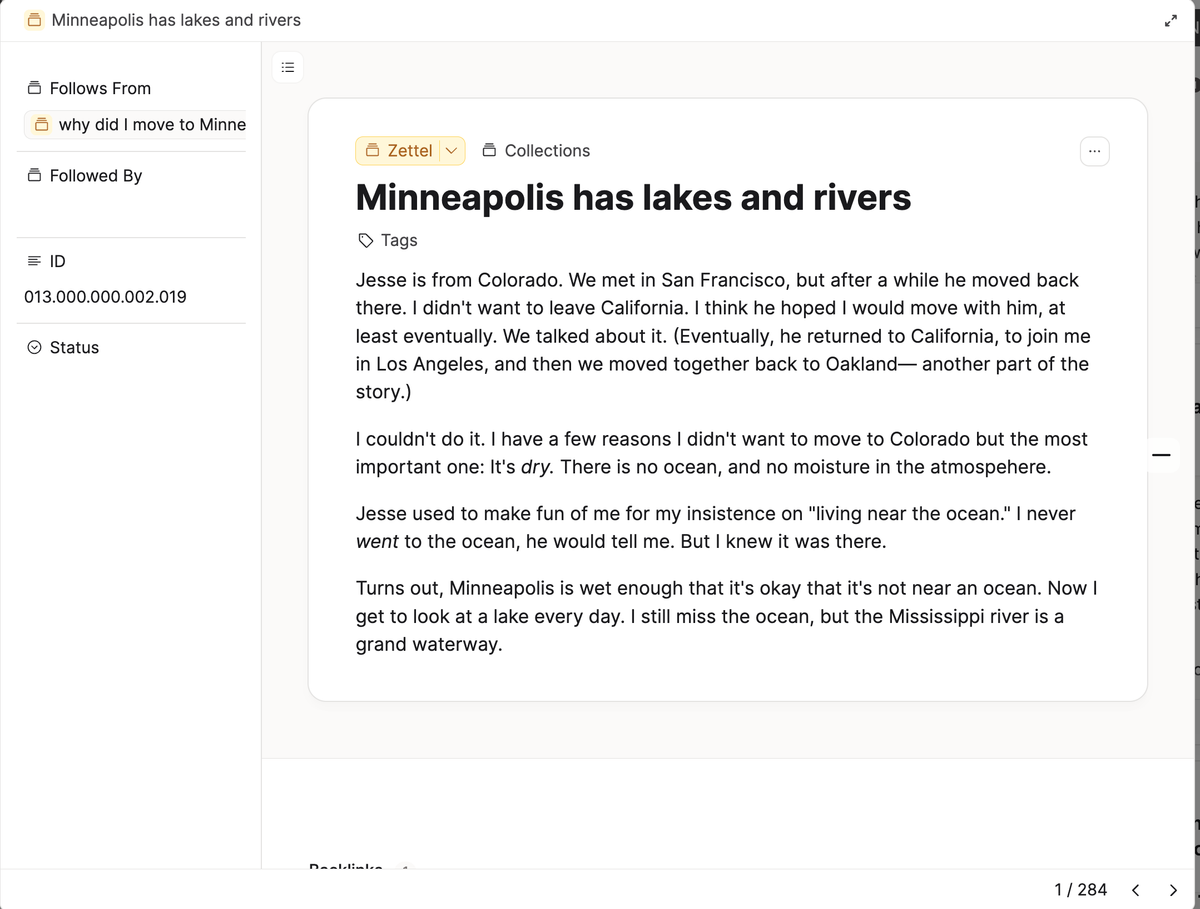
I've implemented the "Zettel" object in Capacities with three metadata fields: An identifier, a "parent," and "children." Parent/child are backlink so adding a zettel as another zettel's parent adds the new zettel to the existing one's children. My IDs are a modified Luhmann ID. I use the same hierachy but instead of alternating letters/numbers I use three digit integers separated by periods, like: 050.001.002.001.003.001
(That's the first child of the third child of the first child of the second child of the first child of the fiftieth top-level Zettel in the collection.)
They're basically redundant with the parent/child metadata but having the ID allows me to sort by ID which I find useful for browsing the Zettelkasten — similar-ish ideas are grouped together.
I mostly write new Zettels by reviewing daily notes with the #unprocessed tag and then adding a Zettelkasten whenever there's an idea that seems like it's worth saving or thinking about more. I also sometimes will add a #fleeting note to an entry in Capacities if I'm pretty sure it's going to be a Zettel. Usually when I sit down to work on the Zettelkasten one or two notes will come from those fleeting notes and then a few more will come out of thoughts I had while writing the original note or from reading nearby linked notes.
Reviewing the Zettelkasten
A lot of the value of collecting notes in this way is that it makes it easy for me to review them and continue thinking about them and developing the ideas in them. I do this in two ways.
First, when I create a new Zettel, the ID hierarchy means I need to either find the right place to slot the new card in, or decide to put it at a top level. This usually involves a mix of searching and browsing, and then reading a few of the Zettels that are right next to the point where I insert the new one, and then usually reading a few linked Zettels.
Second, in my daily note, I have a query embedded that selects a random Zettel from the set of all Zettels that don't have very many backlinks yet. So whenever I open Capacities I see a note that I haven't yet integrated well into the overall structure.
Using the Zettelkasten
In practice mostly what the Zettelkasten does is remind me of ideas. I haven't gotten to the point that some people have with the Zettelkasten where they literally write articles in it in pieces and then assemble them. I tend to write directly into the editor of wherever I'm publishing — Ghost, for this newsletter — or into Ulysses when I'm not publishing immediately. I'm very much a "sit down and bang the thing out" kind of writer. But last week's newsletter for instance was an idea I'd been meaning to write about for a while after taking the original note for it while reading Weavers, Scribes and Kings. I probably wouldn't have written that without the review process bringing those Sumeria notes back to me over and over again.
I also have a section of the Zettelkasten where I'm experimenting with using it more... ambitiously? I have about 36 notes right now dedicated to the question, "Why did I move to Minneapolis?" The note for that question has 20 children, and then each of those has (or will have) three or more children elaborating on the answer and asking additional questions. So for instance, one of the top level answers was, "So we could live next door to some particular friends," and then there are follow-up notes exploring how those friends came to be living here and how we originally met those friends and so on. I was making pretty good progress on this and targeting an initial draft being done by September, but then I started, uh, writing a novel, so it's been getting less attention.
(That said, the draft is currently about 6000 words. I will probably end up cutting scope from "absurdly ambitious" to "just the longest piece of writing I've ever published" and make some kind of first draft available to paid subscribers in September-ish.)